
SMART MICROSCOPY
Introduction and Key Principles
SMART MICROSCOPY
Introduction and Key Principles
Smart Microscopy – Background and Application
The development and deployment of automated imaging workflows—ranging from conventional microscopy to advanced systems used in autonomous vehicles—have progressed through several technological phases.
Today, Smart Microscopy is positioned to transform the Research & Development (R&D) and Quality Control (QC) landscape across multiple industries.
Light microscopes have long served as essential instruments for investigating the micro and, more recently, nanoscale structure of the world.
Across diverse fields, experts have relied on manual observation to build a deep, often highly personal, understanding of specific specimens. Globally, millions of manual assessments are conducted each day: from algae (used as indicators of climate change), to packaging materials (evaluated for QC), to aluminium (monitored for adherence to industrial standards), and human biopsies (critical in diagnostic workflows).

The year 2024 demonstrated the transformative potential of generative artificial intelligence when applied to large language models. AI based assistants are rapidly becoming indispensable tools and will increasingly take over tasks related to qualification, categorisation, solution generation, and even the selection of appropriate actions through naturallanguage reasoning.
It is worth questioning why a senior primarycare physician who has interacted with only tens of thousands of cases would necessarily outperform an AI system capable of analysing hundreds of thousands—or even millions—of cases. While physicians do not work in isolation, the opportunity to enhance human wellbeing through AI assistance is evident.

A comparable model applied to images, rather than language, offers distinct advantages. Deploying such imagebased AI systems in knowledgeintensive environments could have significant impact. Similarly, one may ask why a senior pathologist, with experience in tens of thousands of cases, would outperform an imageanalysis AI trained on magnitudes more data.
Challenges do exist. These include the complexity and scarcity of representative images required to train reliable AI models, as well as the technical components necessary to realise a fully automated imaging workflow tailored to specific applications.
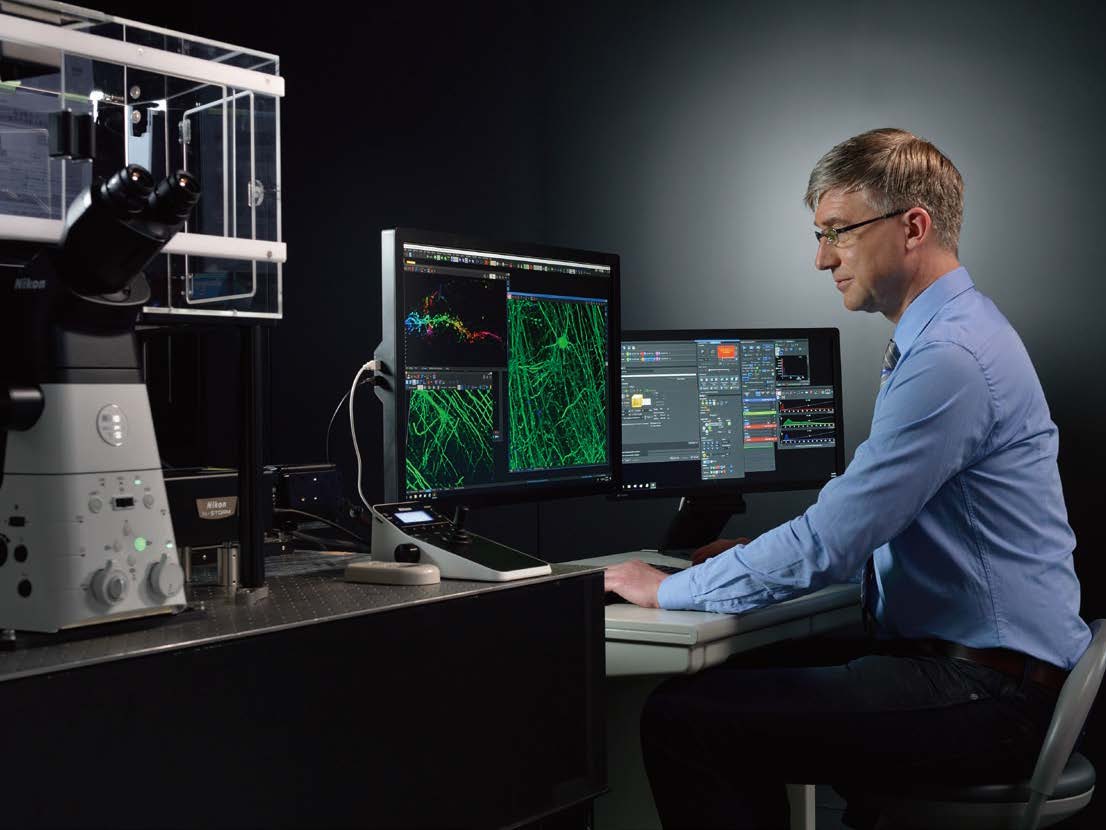
Smart Microscopy can be adopted at varying levels of automation and intelligence within both R&D and QC environments:
1. Image-Analysis-Assisted Decision Making
Purpose: Identification of product and process improvements, and/or pass–fail assessments. Requirements: Human operator, manual microscope, camera, and software with relevant imageanalysis tools (AI assisted or not). Workflow: The operator identifies areas of interest and manually executes the image analysis to support decision making.
2. SemiAutomated ImageAnalysisAssisted Decision Making
Purpose: As above. Requirements: Human operator, motorised microscope, camera, and appropriate software (AI assisted or not). Workflow: The operator initiates the workflow; the software then identifies areas of interest and performs the image analysis to support decision making.
3. Fully Automated ImageAnalysisAssisted Decision Making
Purpose: As above. Requirements: Motorised microscope, camera, and suitable imageanalysis software (AI assisted or not). Workflow: An external trigger initiates the workflow; the software autonomously identifies areas of interest and executes the analysis to generate decisions.

All of these configurations qualify as “Smart” systems—meaning intelligent, rather than simply advanced in appearance. However, the degree of automation and the number of feedback loops integrated into the experimental workflow ultimately determine how “smart” the system truly is.
Importantly, all fundamental components required to develop both simple and highly complex Smart Microscopy systems, across industrial and lifescience applications, already exist today.
How BergmanLabora AB can support customers in developing, implementing and maintaining Smart Microscopy systems
Smart Microscopy integrates automated imaging, AI driven analysis, and intelligent workflows to enable faster, more accurate decisionmaking in both research and industrial environments. BergmanLabora AB is well positioned to support customers throughout the entire adoption journey—from defining needs to full operational implementation.
Below is a structured overview of how BergmanLabora AB can provide value.
BergmanLabora AB can support customers in Smart Microscopy through:
- Needs assessment & consulting
- System design and configuration
- Installation, calibration & workflow validation
- Training and skills development
- Traditional and/or AI driven imageanalysis setup
- System integration into laboratory or production environments
- Longterm service and continuous improvement
- Innovation and codevelopment partnershipsReach out to our team of dedicated specialists to find out more about to BergmanLabora AB can support you in transitioning to truly Smart Microscopy.


