
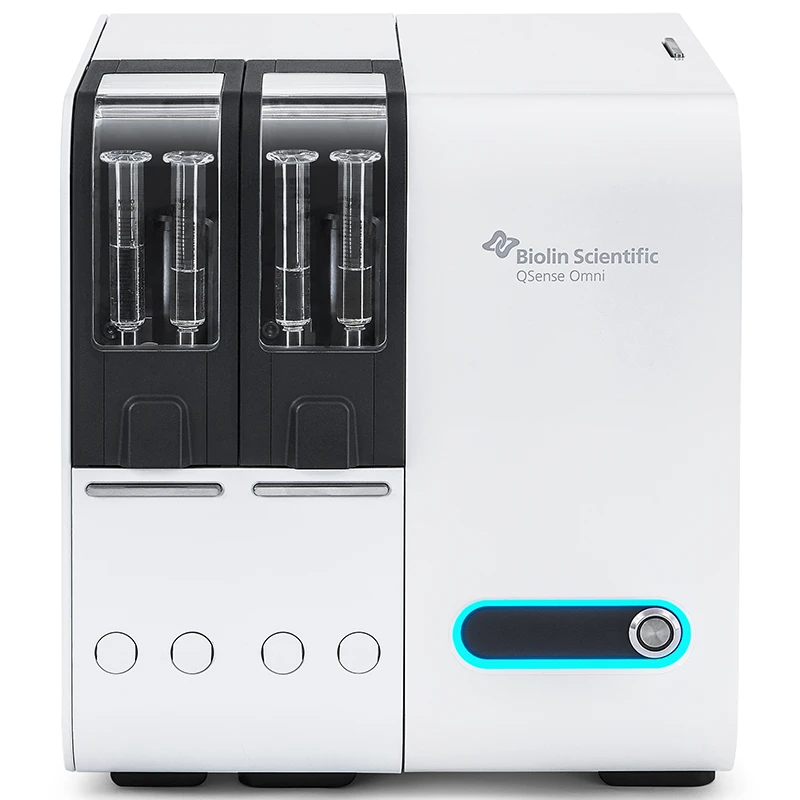


Biolin Scientific QSense Omni
QSense Omni is a new level of QCM-D.
With high sensitivity, unmatched stability and fast liquid yield, you get low detection levels and easy-to-interpret data.
This is for small sample volumes, fast runs and for experts as well as inexperienced users.
Compact instrument with guided workflow, built-in system control and automatic sample handling.
While maintaining flexibility!
Biolin Scientific QSense Omni
QSense Omni is a new level of QCM-D.
With high sensitivity, unmatched stability and fast liquid yield, you get low detection levels and easy-to-interpret data.
This is for small sample volumes, fast runs and for experts as well as inexperienced users.
Compact instrument with guided workflow, built-in system control and automatic sample handling.
While maintaining flexibility!
The most sensitive, flexible and user-friendly QCM-D on the market sets a new standard.
Previous world-leading technology (decay/ringdown) and extremely stable temperature control have been further developed with new instrument design, specifications in a class of their own, a highly intuitive user interface, built-in intelligence and automation.
Omni can be configured with 1 up to 4 individually controlled channels, with or without an external Orbit chamber for those who want to combine QCM-D with other techniques or measure in extreme environments.
With Q-Sense Omni you get
- Very low detection levels – at least 4 times better S/N than the next best system on the market (also a QSense system).
- Easy-to-interpret data – minimal drift, fast fluid exchange and low noise.
- Small sample volumes – direct injection and rapid fluid exchange across the sensor.
- Compact – small-footprint instrument with smart and functional design.
- Easy sensor management – guided installation, automatic diagnostics of sensor quality.
- High reproducibility – easy handling, guided workflow and built-in quality controls.
- Productivity – multi-channel, built-in optimization and control of system data before analysis starts.
- Flexibility – individual control of each sensor channel, methods and sample queues can be modified on the go, external sample chamber for combination measurements or extreme environment.
Why QSense
QSense’s long experience in QCMD (first developer of commercial QCM-D) provides the market’s greatest knowledge and experience of hardware and software, applications and best-practices.
Unlike all other QCM instruments, QCM-D measures both resonant frequency and energy damping of the freely oscillating sensor, providing faster and more accurate results, with additional information on the rheological properties of the film.
Support and participation are part of owning a QSense instrument.
Contact the product specialist:

Susanna Henriksson susanna.henriksson@bergmanlabora.se Tel: 046-501 80 |
Technical specification
Measurement range and capacity:
- Measurement channels: 1 – 4
- Temperature range: 4 to 70 °C
- Sensors (frequency range): 5 MHz (1-72)
- Number of measured harmonics: 7, allows for full viscoelastic modeling
Sample and fluidics:
- Volume above sensor: ~ 20 μl
- Minimum sample volume: in flow mode ~ 90 μl
- Flow rates: Typical flow rate 20 µl/min.
Settable flow speed range 1-200 µl/min
Performance Characteristics:
- Maximum time resolution: 300 datapoints per second (each datapoint represents an f and D value)
- Sensitivity / LOD and Noise: a) Minimum frequency noise: 0.0045 Hz.
- Long-term stability
b)
c) Temperature: < 0.01˚C, Frequency: << 1 Hz/h, Dissipation: << 0.15∙10-6 /h
The most sensitive, flexible and user-friendly QCM-D on the market sets a new standard.
Previous world-leading technology (decay/ringdown) and extremely stable temperature control have been further developed with new instrument design, specifications in a class of their own, a highly intuitive user interface, built-in intelligence and automation.
Omni can be configured with 1 up to 4 individually controlled channels, with or without an external Orbit chamber for those who want to combine QCM-D with other techniques or measure in extreme environments.
With Q-Sense Omni you get
- Very low detection levels – at least 4 times better S/N than the next best system on the market (also a QSense system).
- Easy-to-interpret data – minimal drift, fast fluid exchange and low noise.
- Small sample volumes – direct injection and rapid fluid exchange across the sensor.
- Compact – small-footprint instrument with smart and functional design.
- Easy sensor management – guided installation, automatic diagnostics of sensor quality.
- High reproducibility – easy handling, guided workflow and built-in quality controls.
- Productivity – multi-channel, built-in optimization and control of system data before analysis starts.
- Flexibility – individual control of each sensor channel, methods and sample queues can be modified on the go, external sample chamber for combination measurements or extreme environment.
Why QSense
QSense’s long experience in QCMD (first developer of commercial QCM-D) provides the market’s greatest knowledge and experience of hardware and software, applications and best-practices.
Unlike all other QCM instruments, QCM-D measures both resonant frequency and energy damping of the freely oscillating sensor, providing faster and more accurate results, with additional information on the rheological properties of the film.
Support and participation are part of owning a QSense instrument.
Contact the product specialist:
|
Susanna Henriksson susanna.henriksson@bergmanlabora.se Tel: 046-501 80 |
Technical specification
Measurement range and capacity:
- Measurement channels: 1 – 4
- Temperature range: 4 to 70 °C
- Sensors (frequency range): 5 MHz (1-72)
- Number of measured harmonics: 7, allows for full viscoelastic modeling
Sample and fluidics:
- Volume above sensor: ~ 20 μl
- Minimum sample volume: in flow mode ~ 90 μl
- Flow rates: Typical flow rate 20 µl/min.
Settable flow speed range 1-200 µl/min
Performance Characteristics:
- Maximum time resolution: 300 datapoints per second (each datapoint represents an f and D value)
- Sensitivity / LOD and Noise: a) Minimum frequency noise: 0.0045 Hz.
- Long-term stability
b)
c) Temperature: < 0.01˚C, Frequency: << 1 Hz/h, Dissipation: << 0.15∙10-6 /h
Need help choosing the right product?
Our product specialists can help you choose the right instrument for your business.


