
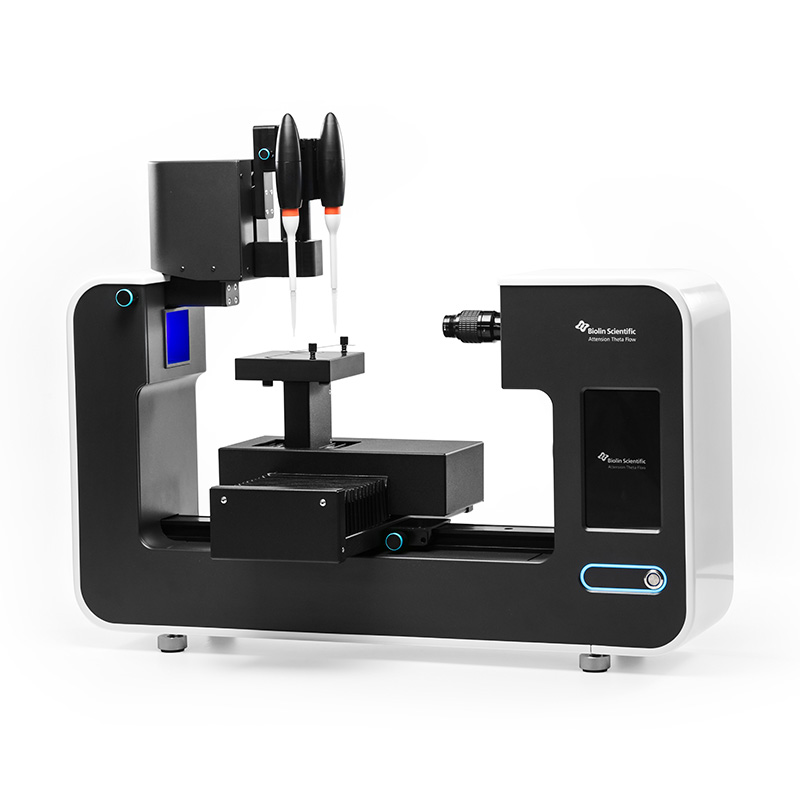
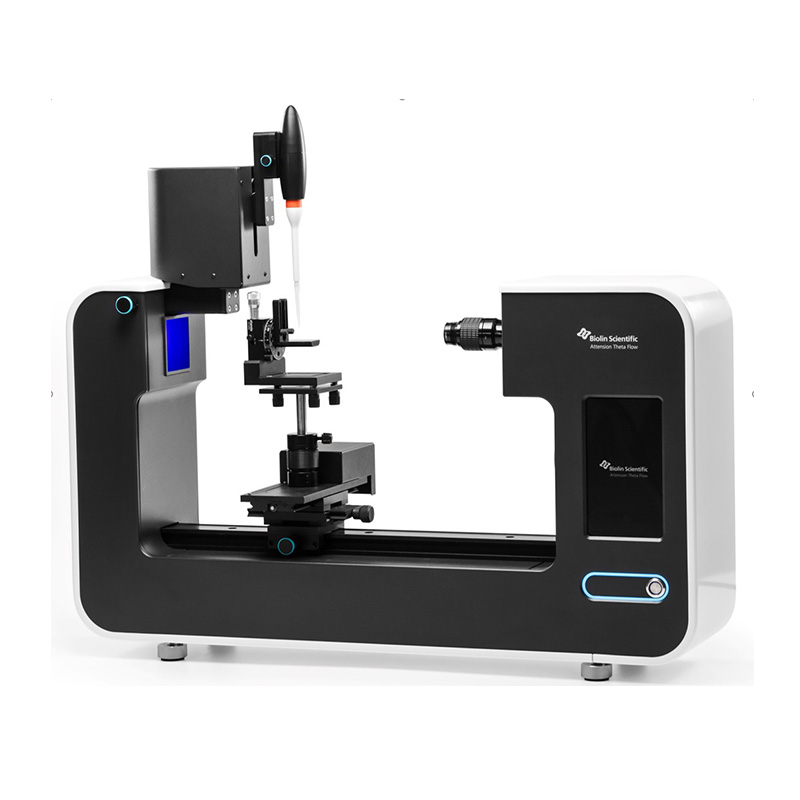
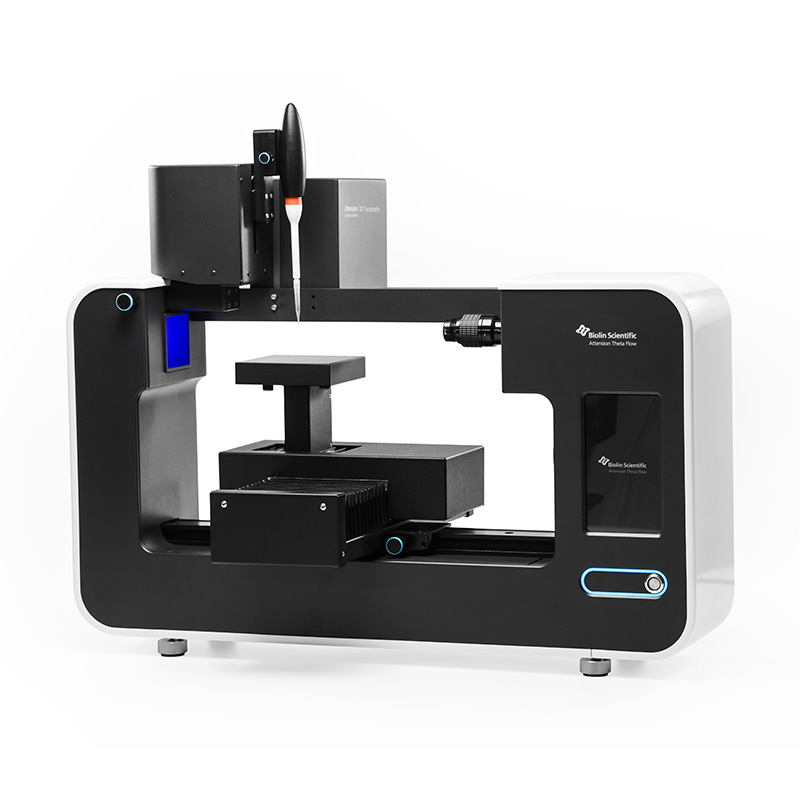
Biolin Scientific Theta Flow
High-performance premium model for advanced surface research and quailtet control.
Theta Flow offers a whole new level of camera specifications, great flexibility and unbeatable ease of use.
A contact angle instrument that provides contact angle, surface energy and wettability measurements in a class of their own.
Biolin Scientific Theta Flow
High-performance premium model for advanced surface research and quailtet control.
Theta Flow offers a whole new level of camera specifications, great flexibility and unbeatable ease of use.
A contact angle instrument that provides contact angle, surface energy and wettability measurements in a class of their own.
Quality and function in a class of their own
- Static contact angle
- Dynamic contact angle
- Roll-off angle
- Ytenergi / Surface Free Energy
- Surface tension
- Interfacial voltage / Interphase voltage
- Batchwise contact angle
- Contact angle corrected for surface roughness
- Interphase Rheology / Viscoelasticity
- Measurements in high pressure and high temperature
Automation and embedded intelligence
Camera with autofocus – always sharp image, even at dynamic contact angle or other more demanding applications Automatic surface mapping – the sample is moved between predetermined points and the OneAttension software processes and reports data automatically.
Precision and reliable results
With a 5 MP camera, built-in DropletPlus feature to further improve image quality, sensors that measure and log ambient temperature and humidity, electronic sensing of horizontal position and camera angle, ThetaFlow is the most reliable and repeatable contact angle system available.
The camera performance of Theta Flow provides you with contact angle, wettability and surface energy/SFE with the best possible accuracy and repeatability.
With a frame rate of over 3400 fps, you can follow very fast processes, such as analyzing superhydrophobic surfaces.
The unique topography accessory also allows you to measure the effect of sample surface structure on wettability and surface energy.
Easy to use
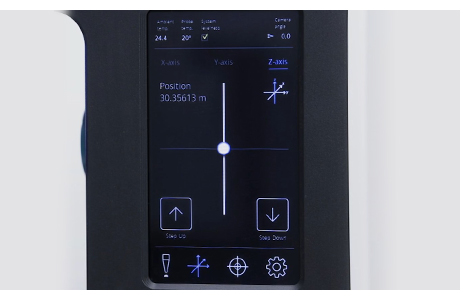
- The instrument’s touch screen makes sample and instrument preparation close and fast.
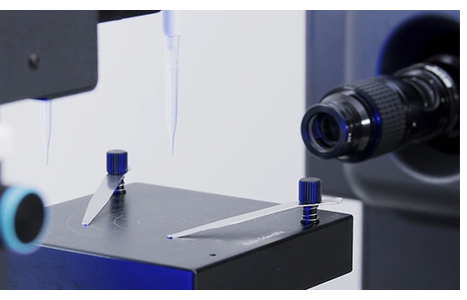
Everything from filling dispensers to positioning samples is easily done right at the instrument. - A specifically soft deposition of the droplet on your substrate minimizes the risk of asymmetric droplet shape and avoids disqualifying outlier values.
- Accurate measurements at every measurement point and repeatable results.
- Dispensers with disposable tips save you time on cleaning and preparation and avoid contamination.
You also need a smaller volume of liquid, especially important if volatile and/or hazardous liquids are used. - The modular design of the instrument allows it to be fully configured according to current needs and easily expanded in the future when you need new functionality.
The system comes with complete software so you can control the instrument and analyze images and data from day one.
Adding additional accessories later is a simple plug & play installation.
Contact the product specialist:
Susanna Henriksson Susanna.henriksson@bergmanlabora.se Tel: 046-501 80
Technical specification
Possible Measurements:
- Static contact angle and captive bubble
- Batch contact angle
- Dynamic contact angle
- Meniscus contact angle
- Surface/Interfacial tension
- 3D surface roughness and roughness-corrected contact angle (optional accessory needed)
- Interfacial rheology (optional accessory needed)
- Surface free energy (Zisman Plot, OWRK/Extended Fowkes, van Oss Acid-Base, Wu, Neumann’s Equation of State, Schultz 1 and 2)
Software and hardware:
Measuring range (°, mN/m) 0…180, 0.01…2000
Accuracy (°, mN/m) ±0.1, ±0.01
Maximum sample size (mm) Unlimited×100×320
Integrated sample holdersMaximumresolution (px) 2592 x 2048 (5 MP)
Maximum measuring speed (fps) 3422
Camera CMOS 1” USB 3.0 digital camera with zoom
Image focusing Software-controlled autofocus, manual fine focus in optics
Image quality Enhanced with DropletPlus technology, native
Camera protection Inside instrument covers
Camera view angle (°) -4.5 … 2.5, with digital scale
Light source and size LED based homogeneous background lighting, 62 x 62 mm
Field of view (Ø, mm) 1.44…45.3
Measurement indicator LED Integrated touch displayEnvironmentmonitoringDisposabletipdispensingSoftware OneAttension, includes all measurement modes
Dimensions – Basic frame (L×W×H, mm) 765 x 230 x 435
Weight Basic frame (kg) 29
Power supply (VAC) 100…240
Frequency (Hz) 50…60
Application
An optical tensiometer can be used for many different types of analysis, below are some examples.
Contact angle
Theta Flex can be used to measure static, dynamic and surface roughness corrected contact angle.
The main components of an optical tensiometer are the camera, dispenser to dispense a drop, sample table and light source to illuminate the drop on the sample table. Optical tensiometers are sometimes also called optical goniometers, contact angle goniometers, contact angle meters or drop shape analyzers.
Static contact angle with optical tensiometer
Sessile (sitting/resting) drop analysis is the most common method for contact angle measurement.
A drop is placed on a substrate/solid surface and the camera takes an image of the drop.
The static contact angle is then defined by fitting the Young-Laplace equation around the drop (other algorithms such as circular and polynomial can also be used).
In practice, a series of images are taken over time, so a process can also be followed and studied in time resolution. It is also possible to measure on inverted sessile systems, where the drop comes from below to a substrate, so-called captive bubble.
This technique is used when the substrate is very hydrophilic and conventional measurement is difficult to achieve, or in three-phase systems where the solid substrate is in liquid, for example an oil drop on a mineral surface in a salt water solution.
Dynamic contact angle
Dynamic contact angle is an increasingly used and important method, as real surfaces are rarely ideal and measured static contact angle does not provide sufficient information about surface properties.
There are two main methods for measuring dynamic contact angle with optical tensiometers, the needle method and the slope method. 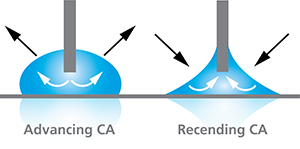 With the needle method, a small drop is created on the solid substrate, the needle is left in the drop and used to fill more liquid into the drop while analyzing contact angle while increasing volume.
This gives the Advancing angle.
Then the volume in the droplet is reduced correspondingly and meanwhile the Receeding angle is measured.
The difference between advancing and receiving angle is an indication of surface inhomogeneity (chemical or steric) and is called hysteresis.
This is a method often used to measure dynamic contact angle on superhydrophobic surfaces.
The second method of dynamic contact angle is based on the principle of tilting/tilting the sample gradually until a freestanding droplet starts to move.
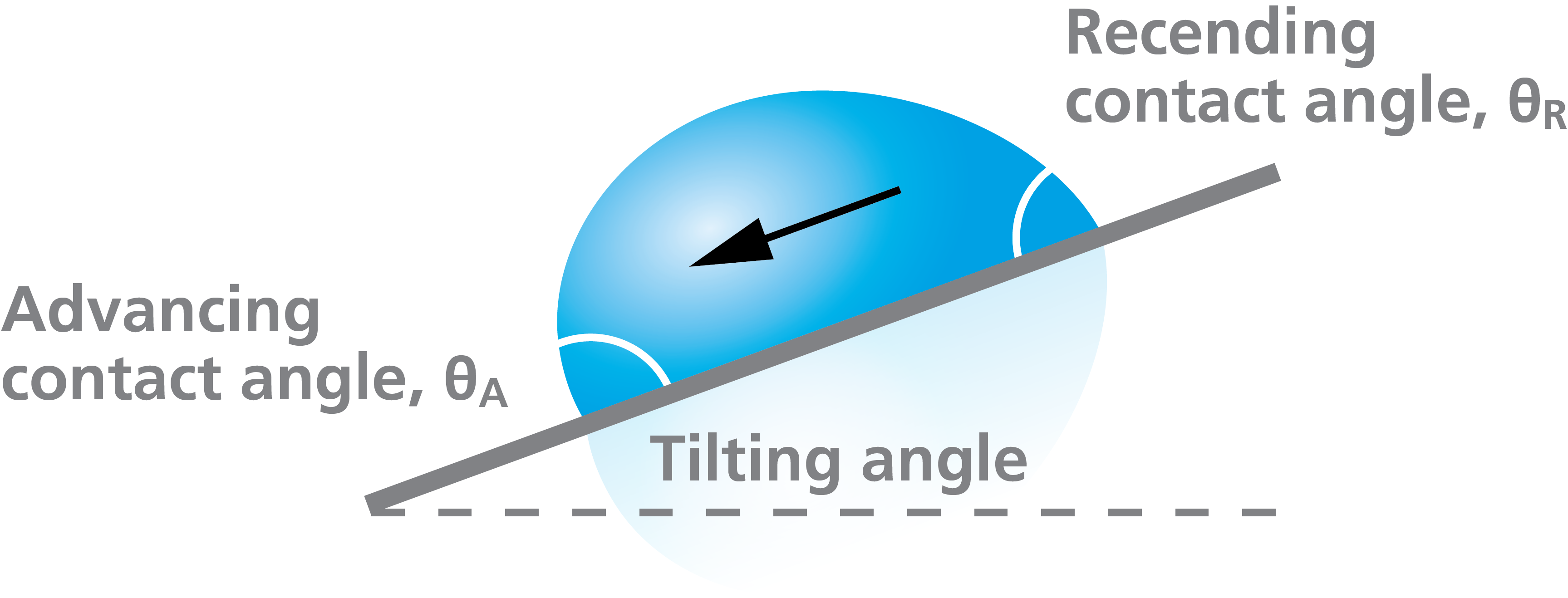
The advancing angle is measured at the front of the drop just at the moment when the drop starts to move, and the receiving angle is measured at the same time in the trailing/rear part of the drop.
This method can also determine what is called the roll-off angle, i.e. the angle at which the drop starts to move.
A small roll-off angle is associated with small hysteresis (the difference between advancing and receiving).
The tilt can be created by tilting only the sample table, or by tilting the whole instrument, thus maintaining a baseline relative to the optical view.
Contact angle measurement with surface roughness correction
Theta Flex and Theta Flow can be configured with a built-in optical profilometer, which measures surface roughness at the same point as the contact angle. Since surface roughness has an impact on measured contact angle values, it can be valuable to obtain parameters for the surface topography.
2D and 3D images, as well as profilometric parameters such as r (ratio between real and theoretical drop area), Sdr, Sa, Sq and others are reported.
The system can also use r and the Wenzel equation to calculate contact angle and SFE with correction for surface roughness.
The accessory can be used for measuring surface roughness in the length scale 1-60 um.
The Wenzel correction assumes a topography that provides wetting of the entire real surface.
Surface voltage/intermediate phase voltage
Surface tension can be measured by optical tensiometry using a method called Pendant Drop, in which a liquid droplet hanging from the dispenser tip/needle is analyzed.
Surface tension and interfacial tension can be related to the shape of the drop, and calculated using iterative Young-Laplace fitting, where the density difference between liquid/gas and liquid/liquid needs to be known.
The liquid volume must be large enough to give a droplet shape.
Inverted measurements can also be made, where the lighter phase rises from the needle into a heavier phase, using a hook-shaped needle.
An example of the use of this technique is to study interphase tension between oil and water. This method is sometimes called Rising bubble or Inverted pendant drop.
Interfacial Rheology
Using a pulsating droplet, rheological properties can also be studied by optical tensiometer.
Quality and function in a class of their own
- Static contact angle
- Dynamic contact angle
- Roll-off angle
- Ytenergi / Surface Free Energy
- Surface tension
- Interfacial voltage / Interphase voltage
- Batchwise contact angle
- Contact angle corrected for surface roughness
- Interphase Rheology / Viscoelasticity
- Measurements in high pressure and high temperature
Automation and embedded intelligence
Camera with autofocus – always sharp image, even at dynamic contact angle or other more demanding applications Automatic surface mapping – the sample is moved between predetermined points and the OneAttension software processes and reports data automatically.
Precision and reliable results
With a 5 MP camera, built-in DropletPlus feature to further improve image quality, sensors that measure and log ambient temperature and humidity, electronic sensing of horizontal position and camera angle, ThetaFlow is the most reliable and repeatable contact angle system available.
The camera performance of Theta Flow provides you with contact angle, wettability and surface energy/SFE with the best possible accuracy and repeatability.
With a frame rate of over 3400 fps, you can follow very fast processes, such as analyzing superhydrophobic surfaces.
The unique topography accessory also allows you to measure the effect of sample surface structure on wettability and surface energy.
Easy to use
- The instrument’s touch screen makes sample and instrument preparation close and fast.
Everything from filling dispensers to positioning samples is easily done right at the instrument. - A specifically soft deposition of the droplet on your substrate minimizes the risk of asymmetric droplet shape and avoids disqualifying outlier values.
- Accurate measurements at every measurement point and repeatable results.
- Dispensers with disposable tips save you time on cleaning and preparation and avoid contamination.
You also need a smaller volume of liquid, especially important if volatile and/or hazardous liquids are used. - The modular design of the instrument allows it to be fully configured according to current needs and easily expanded in the future when you need new functionality.
The system comes with complete software so you can control the instrument and analyze images and data from day one.
Adding additional accessories later is a simple plug & play installation.
Contact the product specialist:
Susanna Henriksson Susanna.henriksson@bergmanlabora.se Tel: 046-501 80
Technical specification
Possible Measurements:
- Static contact angle and captive bubble
- Batch contact angle
- Dynamic contact angle
- Meniscus contact angle
- Surface/Interfacial tension
- 3D surface roughness and roughness-corrected contact angle (optional accessory needed)
- Interfacial rheology (optional accessory needed)
- Surface free energy (Zisman Plot, OWRK/Extended Fowkes, van Oss Acid-Base, Wu, Neumann’s Equation of State, Schultz 1 and 2)
Software and hardware:
Measuring range (°, mN/m) 0…180, 0.01…2000
Accuracy (°, mN/m) ±0.1, ±0.01
Maximum sample size (mm) Unlimited×100×320
Integrated sample holdersMaximumresolution (px) 2592 x 2048 (5 MP)
Maximum measuring speed (fps) 3422
Camera CMOS 1” USB 3.0 digital camera with zoom
Image focusing Software-controlled autofocus, manual fine focus in optics
Image quality Enhanced with DropletPlus technology, native
Camera protection Inside instrument covers
Camera view angle (°) -4.5 … 2.5, with digital scale
Light source and size LED based homogeneous background lighting, 62 x 62 mm
Field of view (Ø, mm) 1.44…45.3
Measurement indicator LED Integrated touch displayEnvironmentmonitoringDisposabletipdispensingSoftware OneAttension, includes all measurement modes
Dimensions – Basic frame (L×W×H, mm) 765 x 230 x 435
Weight Basic frame (kg) 29
Power supply (VAC) 100…240
Frequency (Hz) 50…60
Application
An optical tensiometer can be used for many different types of analysis, below are some examples.
Contact angle
Theta Flex can be used to measure static, dynamic and surface roughness corrected contact angle.
The main components of an optical tensiometer are the camera, dispenser to dispense a drop, sample table and light source to illuminate the drop on the sample table. Optical tensiometers are sometimes also called optical goniometers, contact angle goniometers, contact angle meters or drop shape analyzers.
Static contact angle with optical tensiometer
Sessile (sitting/resting) drop analysis is the most common method for contact angle measurement.
A drop is placed on a substrate/solid surface and the camera takes an image of the drop.
The static contact angle is then defined by fitting the Young-Laplace equation around the drop (other algorithms such as circular and polynomial can also be used).
In practice, a series of images are taken over time, so a process can also be followed and studied in time resolution. It is also possible to measure on inverted sessile systems, where the drop comes from below to a substrate, so-called captive bubble.
This technique is used when the substrate is very hydrophilic and conventional measurement is difficult to achieve, or in three-phase systems where the solid substrate is in liquid, for example an oil drop on a mineral surface in a salt water solution.
Dynamic contact angle
Dynamic contact angle is an increasingly used and important method, as real surfaces are rarely ideal and measured static contact angle does not provide sufficient information about surface properties.
There are two main methods for measuring dynamic contact angle with optical tensiometers, the needle method and the slope method. With the needle method, a small drop is created on the solid substrate, the needle is left in the drop and used to fill more liquid into the drop while analyzing contact angle while increasing volume.
This gives the Advancing angle.
Then the volume in the droplet is reduced correspondingly and meanwhile the Receeding angle is measured.
The difference between advancing and receiving angle is an indication of surface inhomogeneity (chemical or steric) and is called hysteresis.
This is a method often used to measure dynamic contact angle on superhydrophobic surfaces.
The second method of dynamic contact angle is based on the principle of tilting/tilting the sample gradually until a freestanding droplet starts to move.
The advancing angle is measured at the front of the drop just at the moment when the drop starts to move, and the receiving angle is measured at the same time in the trailing/rear part of the drop.
This method can also determine what is called the roll-off angle, i.e. the angle at which the drop starts to move.
A small roll-off angle is associated with small hysteresis (the difference between advancing and receiving).
The tilt can be created by tilting only the sample table, or by tilting the whole instrument, thus maintaining a baseline relative to the optical view.
Contact angle measurement with surface roughness correction
Theta Flex and Theta Flow can be configured with a built-in optical profilometer, which measures surface roughness at the same point as the contact angle. Since surface roughness has an impact on measured contact angle values, it can be valuable to obtain parameters for the surface topography.
2D and 3D images, as well as profilometric parameters such as r (ratio between real and theoretical drop area), Sdr, Sa, Sq and others are reported.
The system can also use r and the Wenzel equation to calculate contact angle and SFE with correction for surface roughness.
The accessory can be used for measuring surface roughness in the length scale 1-60 um.
The Wenzel correction assumes a topography that provides wetting of the entire real surface.
Surface voltage/intermediate phase voltage
Surface tension can be measured by optical tensiometry using a method called Pendant Drop, in which a liquid droplet hanging from the dispenser tip/needle is analyzed.
Surface tension and interfacial tension can be related to the shape of the drop, and calculated using iterative Young-Laplace fitting, where the density difference between liquid/gas and liquid/liquid needs to be known.
The liquid volume must be large enough to give a droplet shape.
Inverted measurements can also be made, where the lighter phase rises from the needle into a heavier phase, using a hook-shaped needle.
An example of the use of this technique is to study interphase tension between oil and water. This method is sometimes called Rising bubble or Inverted pendant drop.
Interfacial Rheology
Using a pulsating droplet, rheological properties can also be studied by optical tensiometer.
Need help choosing the right product?
Our product specialists can help you choose the right instrument for your business.


