
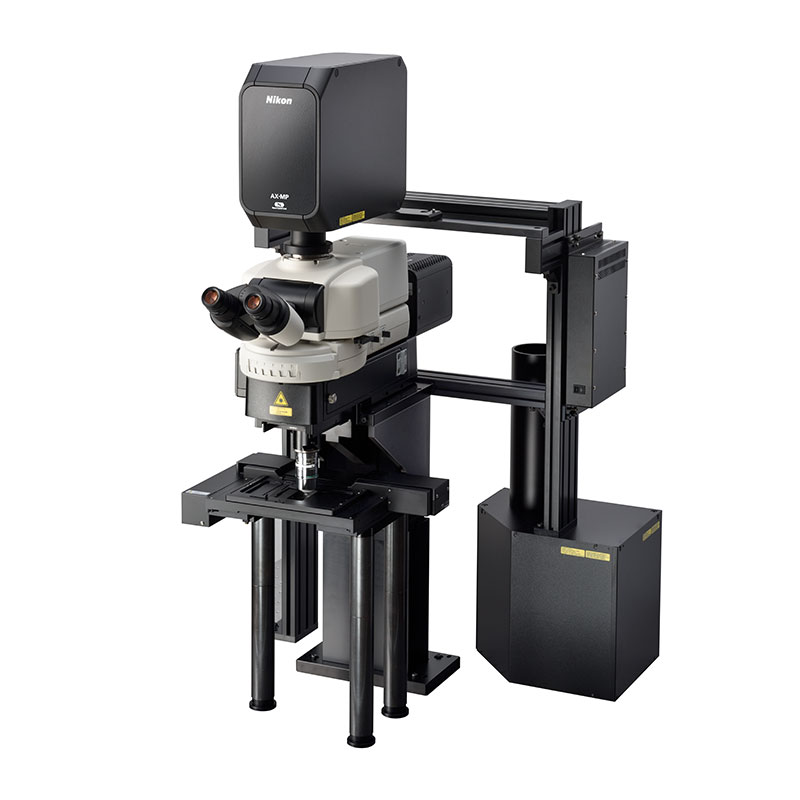
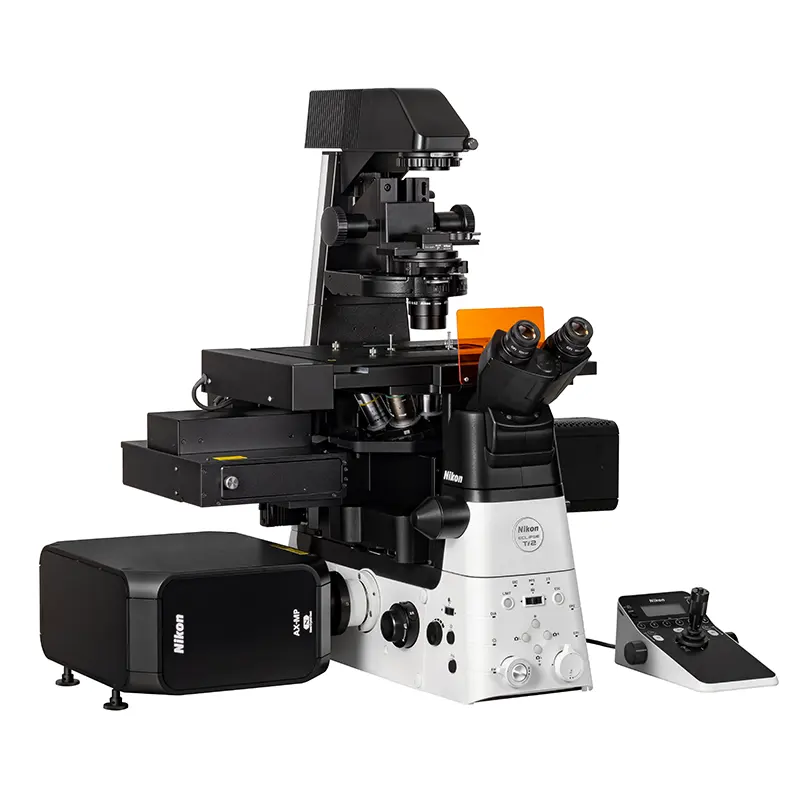
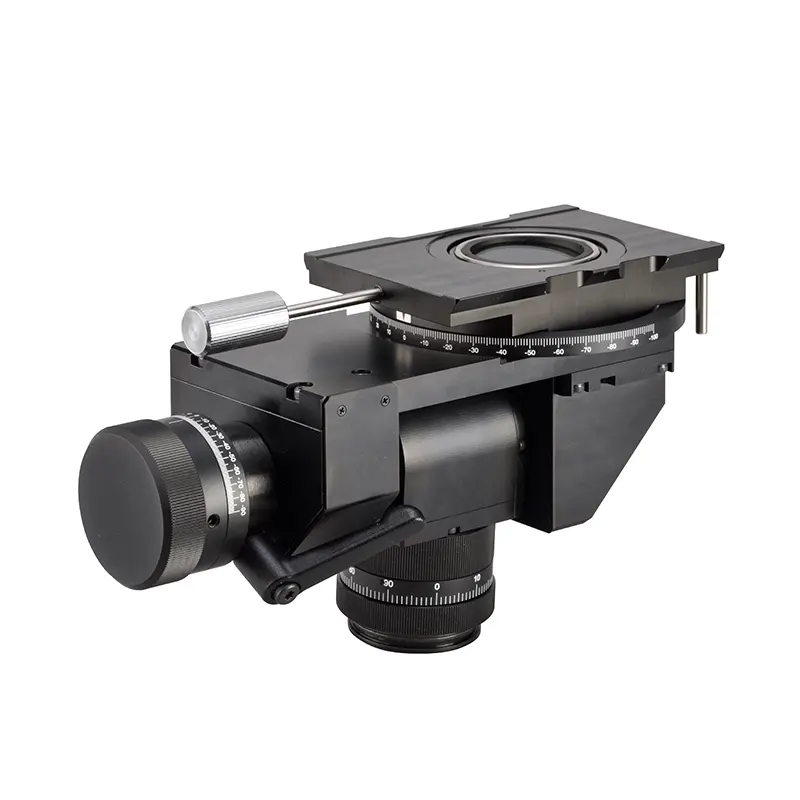
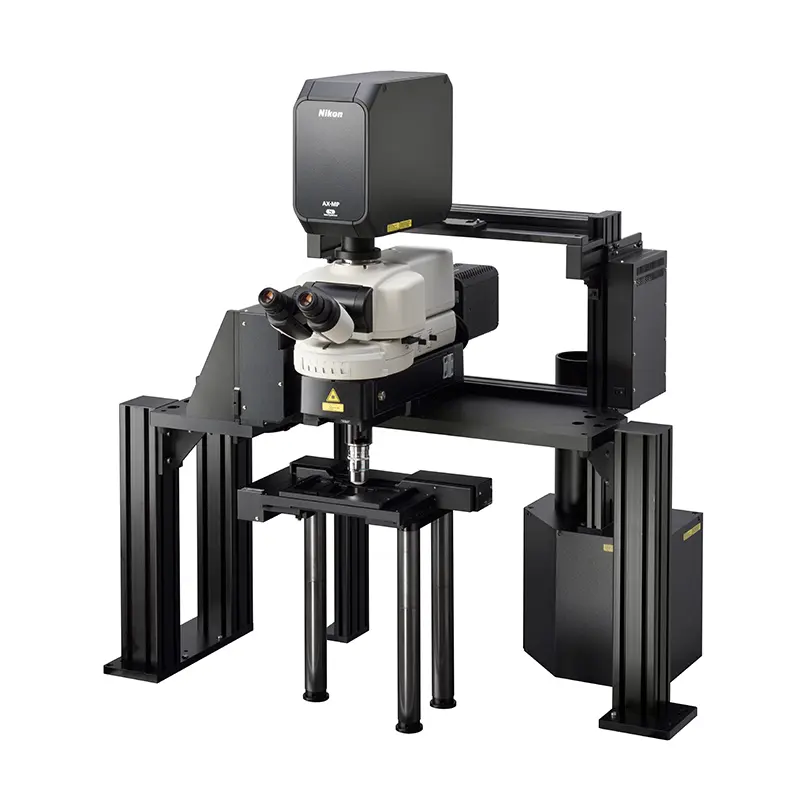
Nikon AX R MP with NSPARC
Enable visualization of signals deep inside living tissue with Nikon’s AX R MP Multiphoton confocal. The AX R MP Multiphoton has all the features of the AX R, but with the ability to use wavelengths up to 1300 nm, as well as super-sensitive NDD detectors, it can visualize signals as deep as living tissue.
Nikon AX R MP with NSPARC
Enable visualization of signals deep inside living tissue with Nikon’s AX R MP Multiphoton confocal. The AX R MP Multiphoton has all the features of the AX R, but with the ability to use wavelengths up to 1300 nm, as well as super-sensitive NDD detectors, it can visualize signals as deep as living tissue.
Speed and high resolution
With Nikon’s innovative hybrid scanner, i.e. a fast galvanometer scanner with high 8k x 8k resolution and an ultra-fast 2k x 2k resonant scanner, they can capture images at speeds from 30 frames per second at 2048 x 512 pixels to up to 720 frames per second at 2048 x 16 pixels. It is possible to switch between resonant scanner and galvanic scanner with a click in the software.
GaAsP NDD detectors for high sensitivity
One problem faced when trying to detect signals deep in tissue is so-called “light scattering”, i.e. tissue scatters the signals you are trying to see. Therefore, conventional detectors are not sensitive enough. NDD (Non-Descanned Detector) detectors are located just behind the rear aperture of the lens and can thus maximally detect these scattered signals.
Dual IR Beam option allows simultaneous detection of 2 fluorochromes
With this option, two wavelengths can be excited simultaneously, a fixed wavelength at 1040 nm and a wavelength range that can be varied between 700-1300 nm. This allows two fluorochromes to be viewed simultaneously, halving the imaging speed. This IR laser can also be used for simultaneous stimulation at one specific wavelength and imaging at another wavelength.

Separation of overlapping emission of fluorochromes
When excited with IR wavelengths, the fluorochromes have a broader absorption profile, which means that you can excite several fluorochromes with the same wavelength. These emission spectra will then overlap and be difficult to distinguish from each other. Nikon has therefore developed a unique “unmixing” technology that allows these overlapping signals to be separated from each other.
AX R MP Multiphoton can be combined with other microscopy techniques
The MP system can also be combined with other microscopy techniques and equipped with visual lasers and standard detectors for conventional confocal imaging. The system can also be equipped with the Nikon NSPARC super-resolution detector.
Contact the product specialist:

Catherine Kitts |

Marie Andersson |
Technical specification
– Scanning unit: 2 laser inputs, 2 signal outputs for standard, spectral and optional detector
– Galvano, 8192 x 8192 pixels, 10 fps (512 x 512 pixels), 240 fps (512 x 16 pixels)
– Resonant, 2048 x 2048 pixels, 30 fps (2048 x 512 pixels), to 720 fps (2048 x 16 pixels)
– FOV: 22 mm
– Pinhole: 1-153 µm
– Option: simultaneous stimulation/dual visualization
– IR laser: 700-1080 nm or 700-1300 nm
– InSight X3 (Spectra-Physics), Chameleon Vision II, Chameleon Discovery NX, AXON 920-1, AXON 920-2, AXON 1064-1, AXON 1064-3(Coherent)
– Visual laser option: 405 nm, 445 nm, 488 nm, 515 nm, 561 nm, 594 nm, 640 nm, 730 nm
– NDD detector for MP:
1080 nm: Episcopic GaAsP NDD (for inverted and upright microscope); Wavelength range: 400 – 650 nm
1300 nm: Episcopic GaAsP NDD (for inverted and upright microscope); Wavelength range: 380 – 750 nm
– Detectors for standard confocal:
NSPARC (Nikon SPatial ARray Confocal) super-resolution detector
2 or 4 channel standard or spectral GaAsP, Ex. Red GaAsP or HS-PMT detector (2 GaAsP, 2 PMT)
Transmission detector
– Microscope: Ti2-E and dedicated MP stand AX-FNSP and AX-FNGP
– Software: NIS-Elements C and C-ER
Speed and high resolution
With Nikon’s innovative hybrid scanner, i.e. a fast galvanometer scanner with high 8k x 8k resolution and an ultra-fast 2k x 2k resonant scanner, they can capture images at speeds from 30 frames per second at 2048 x 512 pixels to up to 720 frames per second at 2048 x 16 pixels. It is possible to switch between resonant scanner and galvanic scanner with a click in the software.
GaAsP NDD detectors for high sensitivity
One problem faced when trying to detect signals deep in tissue is so-called “light scattering”, i.e. tissue scatters the signals you are trying to see. Therefore, conventional detectors are not sensitive enough. NDD (Non-Descanned Detector) detectors are located just behind the rear aperture of the lens and can thus maximally detect these scattered signals.
Dual IR Beam option allows simultaneous detection of 2 fluorochromes
With this option, two wavelengths can be excited simultaneously, a fixed wavelength at 1040 nm and a wavelength range that can be varied between 700-1300 nm. This allows two fluorochromes to be viewed simultaneously, halving the imaging speed. This IR laser can also be used for simultaneous stimulation at one specific wavelength and imaging at another wavelength.
Separation of overlapping emission of fluorochromes
When excited with IR wavelengths, the fluorochromes have a broader absorption profile, which means that you can excite several fluorochromes with the same wavelength. These emission spectra will then overlap and be difficult to distinguish from each other. Nikon has therefore developed a unique “unmixing” technology that allows these overlapping signals to be separated from each other.
AX R MP Multiphoton can be combined with other microscopy techniques
The MP system can also be combined with other microscopy techniques and equipped with visual lasers and standard detectors for conventional confocal imaging. The system can also be equipped with the Nikon NSPARC super-resolution detector.
Contact the product specialist:
|
Catherine Kitts |
Marie Andersson |
Technical specification
– Scanning unit: 2 laser inputs, 2 signal outputs for standard, spectral and optional detector
– Galvano, 8192 x 8192 pixels, 10 fps (512 x 512 pixels), 240 fps (512 x 16 pixels)
– Resonant, 2048 x 2048 pixels, 30 fps (2048 x 512 pixels), to 720 fps (2048 x 16 pixels)
– FOV: 22 mm
– Pinhole: 1-153 µm
– Option: simultaneous stimulation/dual visualization
– IR laser: 700-1080 nm or 700-1300 nm
– InSight X3 (Spectra-Physics), Chameleon Vision II, Chameleon Discovery NX, AXON 920-1, AXON 920-2, AXON 1064-1, AXON 1064-3(Coherent)
– Visual laser option: 405 nm, 445 nm, 488 nm, 515 nm, 561 nm, 594 nm, 640 nm, 730 nm
– NDD detector for MP:
1080 nm: Episcopic GaAsP NDD (for inverted and upright microscope); Wavelength range: 400 – 650 nm
1300 nm: Episcopic GaAsP NDD (for inverted and upright microscope); Wavelength range: 380 – 750 nm
– Detectors for standard confocal:
NSPARC (Nikon SPatial ARray Confocal) super-resolution detector
2 or 4 channel standard or spectral GaAsP, Ex. Red GaAsP or HS-PMT detector (2 GaAsP, 2 PMT)
Transmission detector
– Microscope: Ti2-E and dedicated MP stand AX-FNSP and AX-FNGP
– Software: NIS-Elements C and C-ER
Need help choosing the right product?
Our product specialists can help you choose the right instrument for your business.


